Coral Reef Fish for Beginners: 12 Easy Species to Identify in the Red Sea
The first thing that hits you on a Red Sea reef isn't the coral — it's the traffic. Fish everywhere, at every depth, all moving at once. The trick to identifying them isn't memorising hundreds of species; it's learning a dozen common ones properly, because those twelve turn up on almost every reef here, from a shore dive at Dahab to the drop-offs at Ras Mohammed.
Below are the twelve worth knowing first, grouped by the habits that make them easy to find. Learn the visual cues, then watch what each fish does. Behaviour is usually the quickest way to confirm an identification.
The residents that come to you
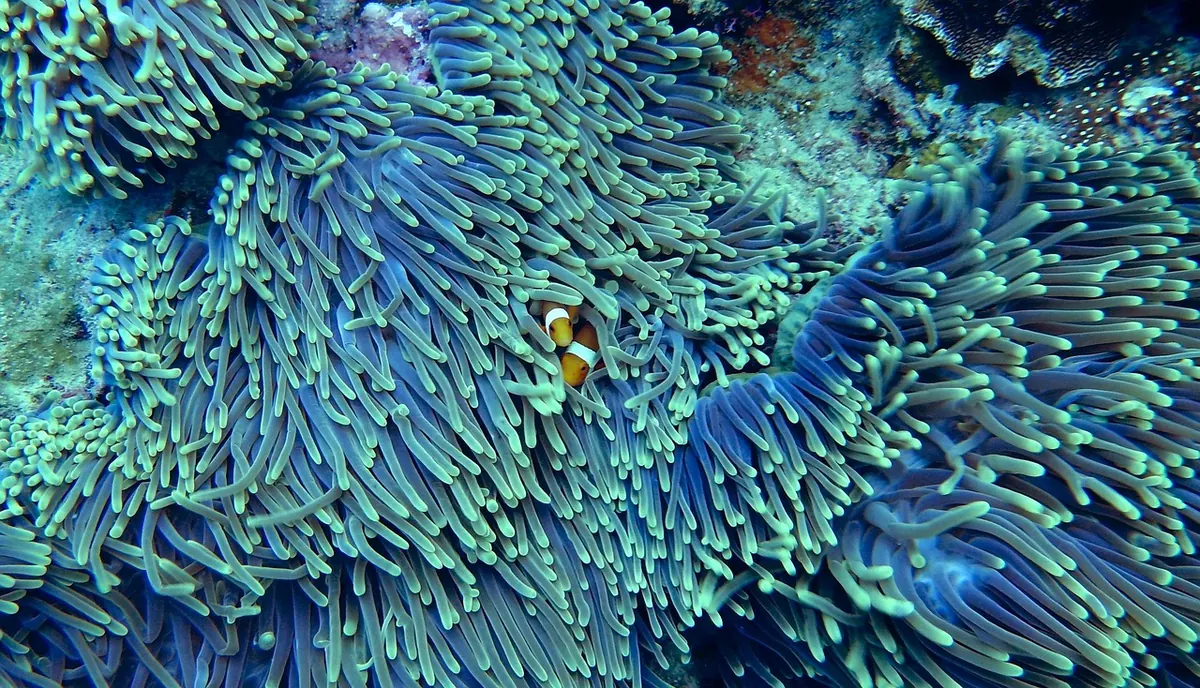
Red Sea clownfish (Amphiprion bicinctus) — orange to dark maroon with two crisp white bars, one behind the eye and one across the middle. It never strays far from its host anemone, so find the anemone and you've found the fish. The larger of a pair is usually the female. When one swims at your mask it's defending a small territory; hold your position rather than reaching in, and it will settle back down.
Blue-green chromis (Chromis viridis) — small, pale blue-green, with a deeply forked tail, hovering in loose clouds above branching corals. They give a reef its shimmer. Watch the shoal rather than a single fish: when something spooks them, the whole group drops into the coral branches and reappears a few seconds later.
Butterflyfish and bannerfish: usually in pairs
Masked butterflyfish (Chaetodon semilarvatus) — buttercup yellow with a soft blue-grey patch over the eye and faint orange vertical lines on the flanks. You'll see them in twos, or in loose gatherings around one coral head, pecking at polyps. The blue eye-patch is the giveaway; nothing else common in the Red Sea looks quite like it.
Red Sea raccoon butterflyfish (Chaetodon fasciatus) — yellow-orange with dark diagonal bands and a black stripe running through the eye. It looks as though it has been drawn in pen and ink, and the bandit mask is what separates it from the masked butterflyfish.
Red Sea bannerfish (Heniochus intermedius) — white with two broad black diagonal bands and a long white dorsal filament trailing above it like a whip. They often hang head-down over coral, picking at the surface. That trailing filament is the easiest way to tell a bannerfish from a butterflyfish at distance.
Angelfish: big, bold, hard to miss
Emperor angelfish (Pomacanthus imperator) — the adult is deep blue with yellow horizontal stripes, a black mask and a yellow tail. The juvenile looks like a different species altogether: dark navy with white and pale blue concentric rings. Plenty of new divers log them separately. If you spot the juvenile, look nearby for the adult, because they share the same patch of reef.
Arabian angelfish (Pomacanthus asfur) — dark blue-black body, yellow tail and a yellow crescent over the upper back. Usually alone, working along a slope or wall. It's slower and shier than the emperor, so give it room and it will carry on feeding.
Tangs: the grazers that patrol
Sohal surgeonfish (Acanthurus sohal) — grey-blue with fine horizontal lines, a bright orange patch on the rear flank and a white spine at the base of the tail. That spine is a scalpel, and this fish is well known for defending its patch. It may swim towards you; keep a metre or two of space and move along rather than standing your ground.
Purple tang (Zebrasoma xanthurum) — deep purple-blue body with a bright yellow tail, oval and flattened side to side, with a pointed snout for grazing algae off rock. Often solitary, often feeding sideways or upside down. Purple plus yellow tail is unmistakable.
Anthias: the orange cloud
Sea goldie (Pseudanthias squamipinnis) — females are orange-gold; males are pinkish-purple with a long trailing third dorsal spine and a blaze of yellow-orange on the flank. They gather on the up-current side of coral heads, feeding on plankton. Watch for a minute and you'll see males chasing one another and herding the group. If the dominant male disappears, one of the females can change sex and take his place.
Triggerfish: bold, busy, occasionally grumpy
Arabian Picasso triggerfish (Rhinecanthus assasi) — cream and tan with bold black bands, blue lines and a black stripe through the eye. Solitary and industrious: it turns rubble, blows jets of water into sand to uncover urchins, and generally behaves as if it owns the place.
Titan triggerfish (Balistoides viridescens) — much larger, dark olive with a pale patch across the upper back and heavy protruding teeth. Most of the time it ignores divers. In the breeding season it digs a nest in sand and defends a cone-shaped territory above it, which is where the reputation comes from. If one squares up to you, move away horizontally rather than swimming upward, and don't cross over the nest patch.
A five-step routine for naming what you see
- Start with shape. Oval and flattened means a tang or angelfish; disc-shaped means a butterflyfish; torpedo-shaped means a wrasse.
- Find the eye stripe. A mask, a band or a patch over the eye is the single most useful marking on Red Sea reef fish.
- Check the tail. Yellow, black-edged, forked or crescent-shaped — the tail often settles an argument between two similar species.
- Note the depth and the habitat. Sand, coral head, wall or open water narrows the list fast.
- Watch for ten seconds before deciding. Feeding, hovering, pairing and territory behaviour confirm what the markings suggested.
Before you get back in the water
Practise on the same site more than once. Repeat visits are worth more than a new reef every day, because you start recognising individual fish and their routines. Take a slate and jot down depth, habitat and one distinguishing feature; a note you wrote yourself beats a photograph you never sort through.
Keep your hands off the reef and don't feed anything. Fish that are used to being fed change their behaviour, which makes them harder to read and puts you closer to teeth than you want to be. Good buoyancy buys you time: hover a little further back, stay still, and the reef comes to you. Within a week of diving here, you'll be naming half the fish you see without thinking about it.
Photo: roeuny / Pixabay