How to Hover Without Touching Coral: Buoyancy Control Drills for Reef Divers
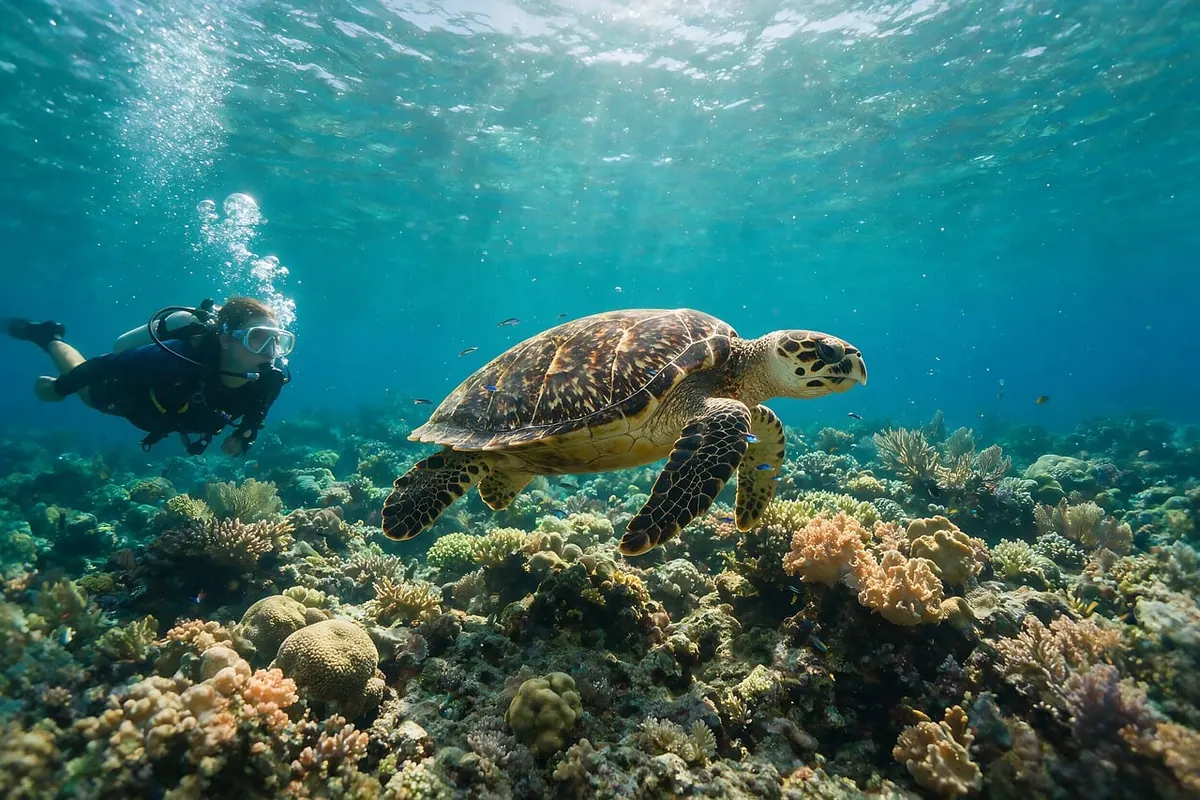
Most reef damage caused by divers isn't deliberate. It's a fin sculled to steady a turn, a knee planted on a bommie while a mask strap is fixed, a hand reaching for what looked like rock. Coral is a thin skin of tiny animals over a stony skeleton; a fingertip's worth of pressure can kill a patch of it, and a break that took decades to grow happens in a second. The fix isn't to be more careful. It's to be neutral enough that touching the reef takes more effort than not touching it.
That neutrality is learned over sand, away from anything you can damage. The drills below take five to ten minutes of a dive each. Do them on a sandy patch or in open blue, then let them show up naturally on the reef.
What neutral actually feels like
Neutral buoyancy isn't a number on a gauge. It's a state you can hold without finning: a normal breath in lifts you gently, a full exhale lowers you, and your hands stay still because they have nothing to do. Alongside it sits trim — lying horizontal, knees slightly bent, head neutral, so your body doesn't act like a sail.
If you can't hover for 30 seconds without moving your fins, no amount of care will keep you off the coral.
Three checks before you start
- Weighting. The right amount of lead lets you hold a safety stop at 5 metres with roughly 50 bar left, not 150. If you're adding air all the way down on every dive, you're probably carrying too much.
- Trim. Everything heavy — cylinder, weights, torch — should be positioned so you float flat, not feet-down. Move weight forward if your legs sink.
- Danglies. Console, octopus, torch lanyard and camera all get clipped short. Anything hanging below you will drag across the reef before you notice it.
Drill 1: the breath hover
The foundation. Sand at five or six metres, no reef within reach.
- Get horizontal and still. Arms folded or tucked against your chest, legs together, knees slightly bent.
- Breathe normally for 30 seconds without touching your BCD. Watch what your body does. Most divers rise on the inhale far more than they expect.
- Adjust with small taps of the inflator — a second of air, no more — and dump in short bursts. Big corrections always overshoot.
- Now hover with your fin tips about a metre above the sand for a full minute, using your lungs for the small stuff.
- Repeat three times. When a minute feels easy, close the gap until your fins sit roughly a hand's width above the sand.
The goal isn't to be motionless. It's that your breathing does the work, quietly, and your hands have nothing to do.
Drill 2: the three-stop ascent
Controlled ascents teach you to hold a depth rather than drift through it.
- From the sand, rise slowly and stop at 12 metres. Hold for 30 seconds without touching anything.
- Continue to 9 metres, stop, hold. Then 6, then 3, then your safety stop.
- At each stop, keep within half a metre of your target depth. Deflate in small taps as you go — the air in your BCD expands on the way up, and one big dump puts you on the bottom.
If you're drifting through your stops, that's the answer you were looking for: less finning, more small corrections.
Drill 3: the arm's-length contour swim
Now take it to the reef, but keep a corridor. Pick a section of wall or slope and swim it with your nearest fin tip holding roughly an arm's length from the structure. No hands out, no fins down. If the reef rises, you rise with it; if it falls away, you follow it down on an exhale rather than a kick.
Do this at an easy pace over 20 or 30 metres. The aim is to trace the shape of the reef while staying too far away to touch it by accident. In surge, add clearance — an extra half metre costs you nothing and saves a great deal.
Drill 4: hover and do something else
Task loading is where good buoyancy usually falls apart. Photographers reach for the reef, or drop onto it, the moment they start framing a shot; the rest of us drift up or down while reading a computer.
Set a hover over sand, then without moving your fins do each of these in turn: read your depth and air, check your buddy's position and signal to them, clear your mask, and take three photographs of the same small object. Any of these that sends you up or down shows the gap between knowing neutral buoyancy and holding it.
If you can't hover and check your air at the same time, you can't hover over a reef and look at anything either. Practise the boring version until it's automatic.
When it starts to go wrong
- Rising: exhale fully first, then a short dump. Tuck your knees towards your chest instead of finning downwards — that instinctive kick is what breaks coral.
- Sinking: a slow breath in, held briefly, plus a one-second inflate.
- Surge pushing you in: back off. Add a metre of clearance, move slightly away from the wall, and let the water settle before you approach again.
- Camera or torch pulling you off balance: clip it off, sort your position, then pick it up again. No shot is worth a broken coral head.
Building the habit
Five minutes of hover work early in every dive, in the first sandy patch you find, and a stop or two on the way up. That's the whole commitment. Keep a loose log — how long you held it, how many BCD corrections you made — so you can watch the corrections fall over a season.
The signs that it's working are quiet ones: your hands stay folded, your fins stop sculling, and the reef passes a comfortable arm's length away without conscious effort. A buoyancy specialty with your training agency gives useful feedback, but most of the gain comes from repetition on ordinary dives. Hover first, look second, and the reef will still be there next time because of it.
Photo: photowoods / Pixabay